

Valid NCP-MCI-6.10 Exam Dumps Ensure you a HIGH SCORE (2026)
Pass NCP-MCI-6.10 Exam with Latest Questions
NEW QUESTION # 41
An administrator wants to enable application discovery on a Nutanix cluster to monitor applications.
An X-Large Prism Central instance is already configured and meets the licensing, CPU, and memory requirements.
Which two other prerequisites must be met before enabling application discovery? (Choose two.)
- A. API key and key ID
- B. Internet connection
- C. Network Controller is enabled
- D. Sufficient Prism Central VM resources
Answer: B,C
Explanation:
Nutanix Application Discovery relies on a combination of Prism Central services and in-guest sensors that collect application metadata, communication patterns, and dependency maps. The internal documentation lists these specific prerequisites before Application Discovery can be enabled:
* "Prism Central must have access to the Internet for sensor downloads, signature updates, and metadata service communication."Application Discovery uses cloud-based metadata to identify applications and services. Without Internet access, Prism Central cannot retrieve application profiles, updated signatures, and dependency mapping definitions.
* "The Network Controller service must be enabled to allow flow-level inspection and communication tracking between VMs."Application Discovery integrates directly with Nutanix Flow's Network Controller to observe traffic flows, which is required for dependency mapping. Without Network Controller enabled, Prism Central cannot monitor or analyze traffic between workloads.
The documentation clarifies that generating API keys is not required to activate Application Discovery, and sufficient Prism Central resources are already assumed as stated in the question.
Therefore, the required prerequisites are Internet connectivity and enabling the Network Controller.
NEW QUESTION # 42
The customer expects to maintain a cluster runway of 9 months. The customer doesn't have a budget for 6 months but they want to add new workloads to the existing cluster.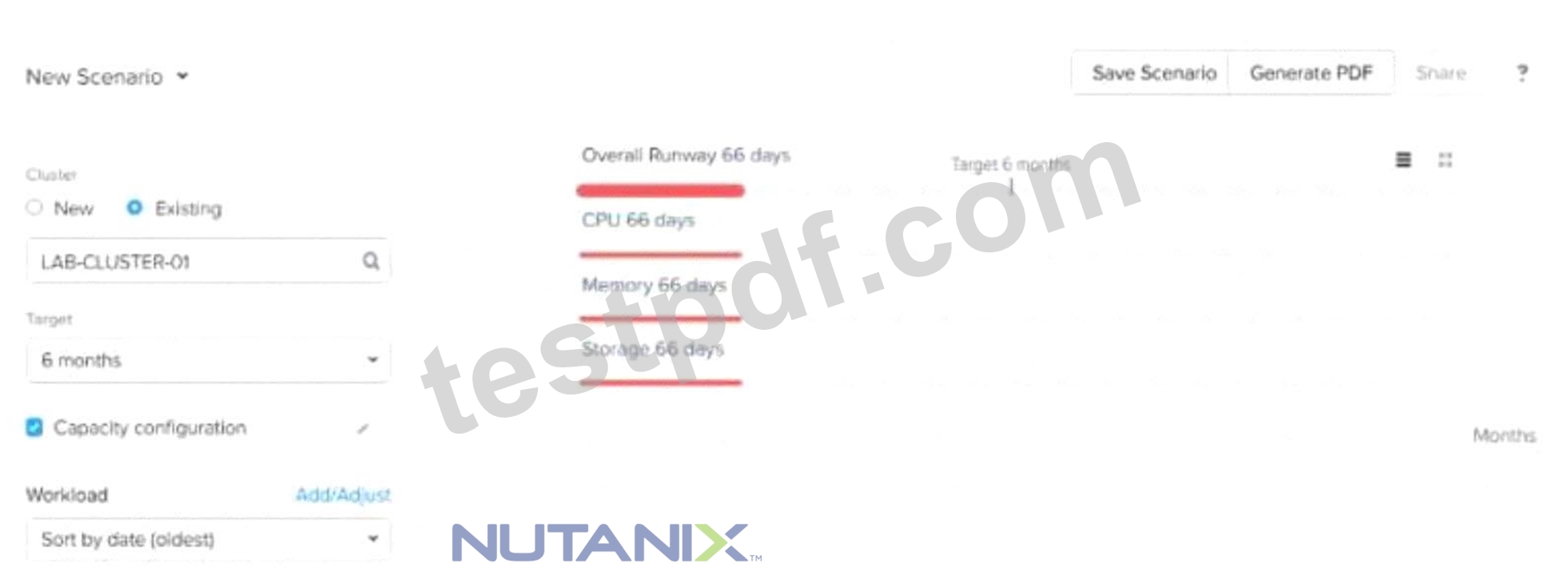
Based on the exhibit, what is required to meet the customer's budgetary timeframe?
- A. Change the target to 9 months.
- B. Postpone the start of new workloads.
- C. Add resources to the cluster.
- D. Delete workloads running on the cluster.
Answer: C
Explanation:
The exhibit shows that theoverall runway is only 66 days, meaning that the current clusterdoes not have enough capacity to sustain workloads for 6 months, let alone 9 months.
* The best solution is toadd resources to the cluster(Option A), such as CPU, memory, or storage, to extend the runway.
* Postponing new workloads(Option B) may help in the short term but does not align with the business need to continue adding workloads.
* Deleting workloads(Option C) is not a viable option because the customer wants to add more, not remove them.
* Changing the target to 9 months(Option D) does not change the actual resource constraints; it only alters the target timeframe.
References:
* Nutanix Prism Central # Capacity Planning and Runway Analysis
* Nutanix Bible # Cluster Resource Management and Scaling
* Nutanix Support KB # How to Extend Cluster Runway with Resource Scaling
NEW QUESTION # 43
Refer to the Exhibit: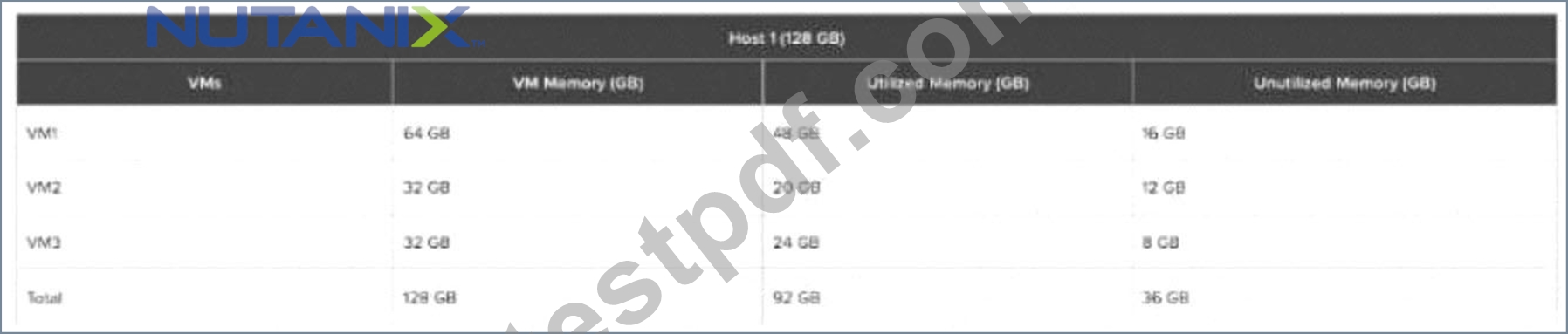
An administrator needs to create two virtual machines: VM4 and VM5 that leverage the memory over-commit feature.
Once VM4 is created and running, the administrator notices that it uses only 28GB of RAM.
What will be the maximum RAM that can be allocated to VM5 so that it can be powered on?
- A. 32GB
- B. 8GB
- C. 4GB
- D. 16GB
Answer: B
Explanation:
Understanding the Exhibit & Memory Allocation
* Thehost has 128GB of physical RAM.
* Thecurrent memory allocationacrossthree VMs (VM1, VM2, VM3) is 128GB, but only92GB is actually utilized.
* This means there is36GB of unutilized memory available for allocation.
Step-by-Step Breakdown
* Existing Memory Usage Before Adding VM4
* Total Physical RAM:128GB
* Used by running VMs (VM1, VM2, VM3):92GB
* Unutilized Memory Available:36GB
* After Creating and Running VM4
* VM4 is allocatedmemory but only utilizes 28GB.
* The table does not show VM4's allocated RAM, but assuming it was given a reasonable allocation, it must have been taken from the36GB unutilized memory pool.
* IfVM4 uses 28GB, theremaining unutilized memory is now (36GB - 28GB) = 8GB.
* Maximum Memory Allocation for VM5
* Sinceonly 8GB remains unutilized, the maximum memory VM5 can be allocated while still allowing it to power on is8GB.
Evaluating the Answer Choices
* (A) 4GB#(Incorrect)
* More memory (8GB) is available, so limiting to 4GB is unnecessary.
* (B) 8GB#(Correct)
* Theremaining unutilized memory after VM4 is 8GB, so VM5 can be allocated up to8GBwhile ensuring it can power on.
* (C) 16GB#(Incorrect)
* Only8GB is left, so 16GB isnot possible.
* (D) 32GB#(Incorrect)
* There isnot enough unutilized memoryto allocate 32GB.
Key Concept: Nutanix Memory Overcommit
* Nutanix AHV supportsmemory overcommit, meaning VMs can be allocated more memory than physically available usingmemory ballooning and swapping.
* However,to power on VM5 without impacting performance, it must fit within the available unutilized memory, which is8GB.
NEW QUESTION # 44
What would cause an LCM pre-check event with the test_esx_entering_mm_pinned_vms check during an AOS upgrade?
- A. VMs on the host have high CPU usage.
- B. Affinity rules are configured to prevent VM migration.
- C. Host has insufficient memory.
- D. HA priority settings are misconfigured.
Answer: B
Explanation:
The test_esx_entering_mm_pinned_vms check in an AOS upgrade validates whether there are any pinned VMs on ESXi hosts, which could prevent host maintenance mode transitions.
From theNutanix Enterprise Cloud Administration (ECA)course materials:
"Affinity or anti-affinity rules that pin VMs to specific hosts prevent those VMs from migrating during host maintenance mode entry. This directly triggers a failure in the LCM precheck test_esx_entering_mm_pinned_vms check."
NEW QUESTION # 45
An administrator needs to perform anLCM upgradeon anAHV host with GPUs.
What additional step is required before upgrading the host?
- A. Update NCC to the latest version and re-run Inventory.
- B. Use Direct Uploads to upload appropriate driver bundles.
- C. Run LCM in dark site mode so it can update AHV independently.
- D. Create an agent VM on each host that has GPU drivers installed.
Answer: A
NEW QUESTION # 46
An administrator is trying toconfigure Metro Availabilitybetween NutanixESXi-based clusters. However, theCompatible Remote Sitesscreen does not list all required storage containers.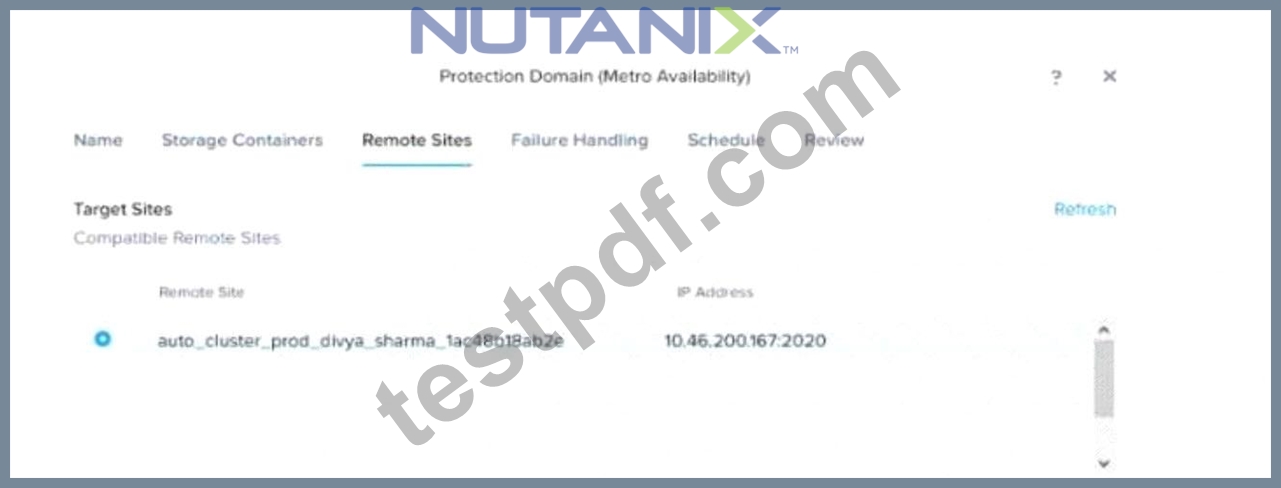
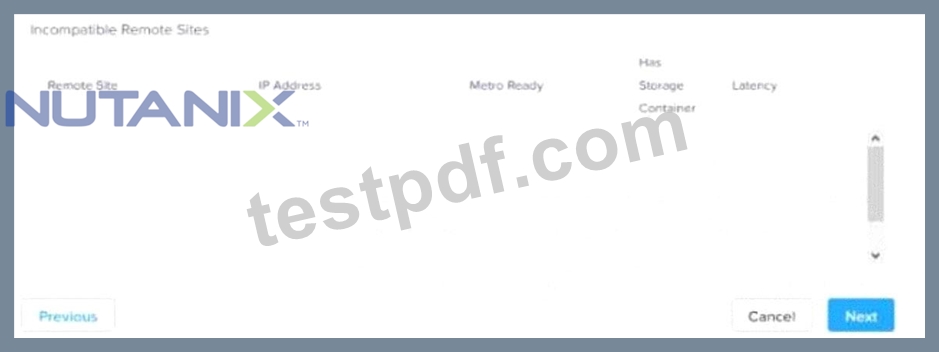
Which two reasons could be a cause for this issue? (Choose two.)
- A. Both storage containers must have the same name.
- B. The destination storage container is not empty.
- C. The remote site storage container has compression enabled.
- D. Source and destination hardware are from different vendors.
Answer: A,B
Explanation:
Metro Availability in Nutanix requires that the primary and secondary storage containers be configured identicallyto ensuredata replication consistency.
* Option C (The destination storage container is not empty) is correct:
* Theremote storage container must be emptybefore Metro Availability can be enabled.
* Existing data can cause conflictsand prevent it from appearing in the "Compatible Remote Sites" list.
* Option D (Both storage containers must have the same name) is correct:
* Metro Availability requires thatstorage containers have identical names across clusters.
* If namesdo not match, thestorage container will not be listed as compatible.
* Option A is incorrect: Metro Availability works regardless of hardware vendor differences.
* Option B is incorrect:Compression does not affect compatibilitybut may impact performance.
References:
* Nutanix Metro Availability Deployment Guide
* Nutanix Best Practices forConfiguring Remote Sites for Metro Availability
* Nutanix KB #Troubleshooting Storage Container Issues in Metro Availability
NEW QUESTION # 47
An administrator is configuring Protection Policies to replicate VMs to a new Nutanix Cloud Cluster (NC2) connected via the Internet.
To comply with an organizational security policy, data sent via the Internet must be encrypted.
Which feature should be taken into account to be compliant?
- A. Configure VMs to use UEFI secure boot.
- B. Configure Data on a self-encrypting drive.
- C. Enable Data at Rest Encryption.
- D. Enable Data-in-Transit Encryption.
Answer: D
Explanation:
Nutanix Protection Policies replicate VM data between clusters using Nutanix's built-in data protection engine. For inter-site or cloud-based replication, Nutanix documentation specifies that replication traffic can be encrypted using the Data-in-Transit Encryption feature. The internal description states:
"Data-in-Transit Encryption secures replication traffic moving between clusters by encrypting data packets before transmission across external or untrusted networks." This is distinct from Data-at-Rest Encryption, which protects stored data on disks but does not secure network traffic. Self-encrypting drives and secure boot only protect the VM locally, not the replication path. Because replication to NC2 travels over the Internet, encryption of the transport channel is mandatory to meet security compliance.
Therefore, the required capability is Data-in-Transit Encryption.
NEW QUESTION # 48
An administrator has configured Metro Availability but a few hours later got an NCC warning:
Node x.x.X.X:
WARN: Break replication timeout of Metro protection domain 'M1' is below the recommended minimum.
What is a possible resolution for this issue?
- A. Update the break_replication_timeout to 5 milliseconds.
- B. Update the break_replication_timeout to 15 seconds
- C. Update the break_replication_timeout to 10 seconds.
- D. Update the break_replication_timeout to 15 milliseconds.
Answer: B
Explanation:
The Nutanix ECA course addresses Metro Availability, a high-availability feature that provides synchronous replication between two Nutanix clusters for zero Recovery Point Objective (RPO) and near-zero Recovery Time Objective (RTO). The NCC warning about thebreak_replication_timeoutbeing below the recommended minimum indicates a configuration issue that could affect the stability of Metro Availability.
Thebreak_replication_timeoutparameter determines how long the Protection Domain (PD) waits before breaking replication if connectivity between the Metro clusters is disrupted.
Extract from Nutanix Enterprise Cloud Administration (ECA) Course Documents:
Module: Data Protection, Section: Metro Availability Configuration"Metro Availability uses synchronous replication to ensure data consistency between two clusters. The break_replication_timeout parameter defines the timeout period for replication. The recommended minimum value is 15 seconds to prevent premature replication breaks due to transient network issues." Module: Nutanix Cluster Check (NCC), Section: Metro Availability Alerts"An NCC warning indicating that the break_replication_timeout for a Metro Protection Domain is below the recommended minimum suggests the timeout is too low, risking unnecessary replication breaks. The recommended setting is 15 seconds to balance stability and responsiveness in Metro Availability setups." Explanation of Options:
A). Update the break_replication_timeout to 10 secondsThis is incorrect. A timeout of 10 seconds is below the recommended minimum of 15 seconds, as specified in the ECA course. Setting the timeout too low increases the risk of replication breaking due to transient network latency or jitter, which could disrupt Metro Availability and cause unnecessary failovers. The ECA documentation warns:"A break_replication_timeout below 15 seconds may lead to frequent replication breaks, reducing the reliability of Metro Availability." B). Update the break_replication_timeout to 5 millisecondsThis is incorrect. A timeout of 5 milliseconds is far too low and impractical for Metro Availability, as even minor network delays would trigger replication breaks. The ECA course does not support millisecond-level timeouts and explicitly recommends 15 seconds as the minimum. Such a low value would destabilize the Metro setup, as noted:"Extremely low timeout values are not supported, as they cause replication to break under normal network conditions." C). Update the break_replication_timeout to 15 millisecondsThis is incorrect. A timeout of 15 milliseconds is still significantly below the recommended minimum of 15 seconds. Similar to option B, this setting would cause replication to break too quickly, undermining the purpose of Metro Availability. The ECA course clarifies:"Timeouts in milliseconds are not recommended for Metro Availability, as they do not account for typical network latency in synchronous replication setups." D). Update the break_replication_timeout to 15 secondsThis is the correct answer. The ECA course explicitly recommends abreak_replication_timeoutof 15 seconds as the minimum to ensure Metro Availability remains stable. This value allows the system to tolerate transient network issues without prematurely breaking replication, maintaining data consistency and availability. The NCC warning indicates the current timeout is below this threshold, and updating it to 15 seconds resolves the issue.
Supporting Extract:"To resolve NCC warnings about break_replication_timeout, set the value to 15 seconds using the ncli command: ncli pd update-metro-avail-pd name=<PD_NAME> break_replication_timeout=15.
This ensures compliance with Nutanix best practices."
Additional Context from ECA:
Metro Availability Overview: Metro Availability synchronously replicates data between two clusters, typically within 100 km, to achieve zero RPO. Thebreak_replication_timeoutis a critical parameter that balances responsiveness to network issues with the need to avoid unnecessary replication breaks. The ECA course notes:"A timeout of 15 seconds is the default and recommended value to handle typical network fluctuations in Metro setups." NCC Warning Resolution: The NCC (Nutanix Cluster Check) monitors cluster health and flags configurations that deviate from best practices. The warning aboutbreak_replication_timeoutindicates a risk to Metro Availability stability, and setting it to 15 seconds aligns with Nutanix recommendations.
Supporting Reference from Web Results:
The Nutanix Support Portal (https://portal.nutanix.com) confirms the ECA guidance:"For Metro Availability, the break_replication_timeout should be set to a minimum of 15 seconds to prevent replication breaks due to transient network issues, as flagged by NCC warnings."
NEW QUESTION # 49
Refer to Exhibit: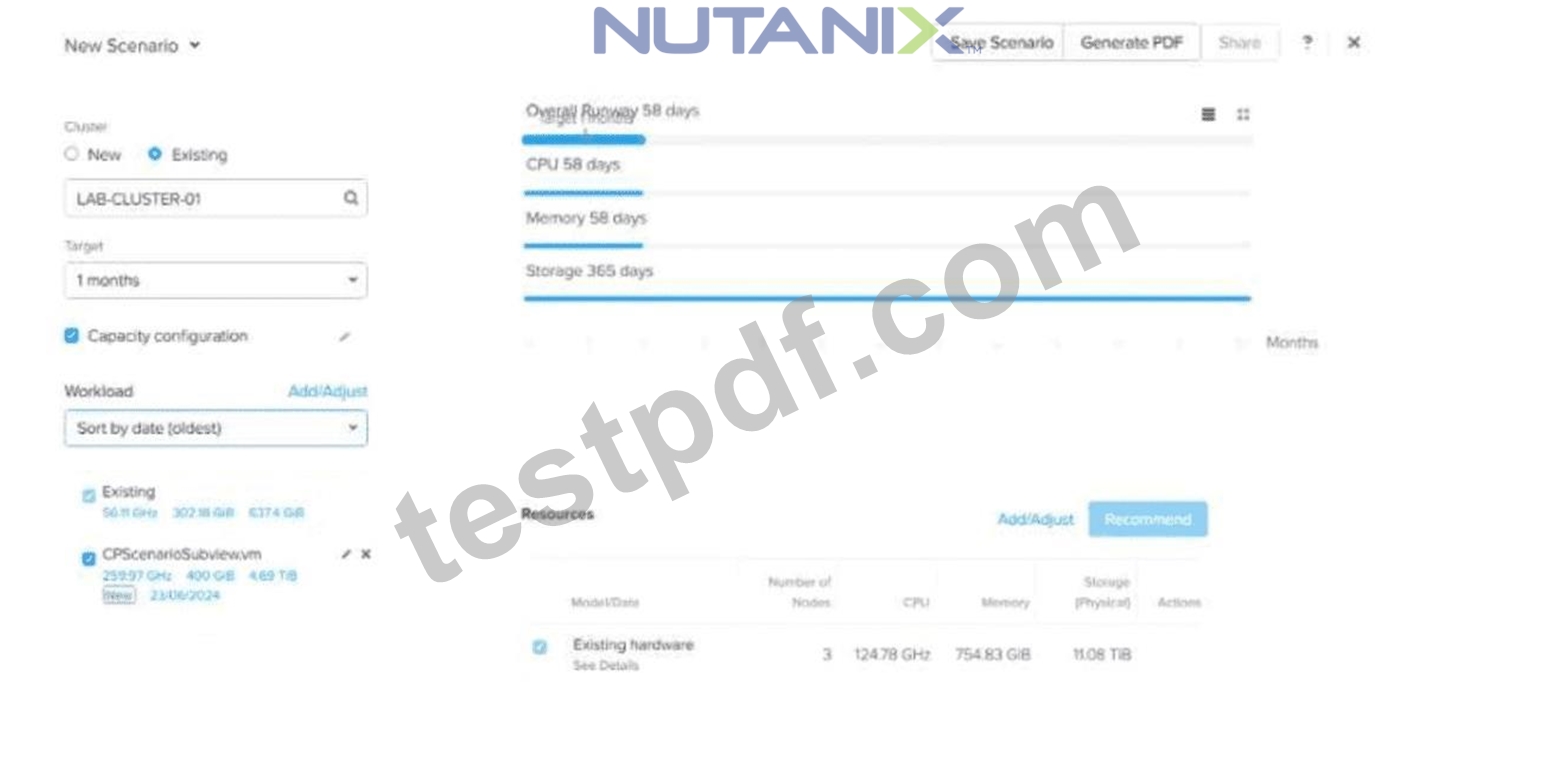
After adding new workloads, why isOverall Runway below 365 daysand the scenario still shows the cluster is in good shape?
- A. Because there are recommended resources.
- B. Because Storage Runway is still good.
- C. Because the Target is 1 month.
- D. Because new workloads are sustainable.
Answer: D
Explanation:
InNutanix Capacity Planning,Overall Runwayrepresents how long the cluster can support current and new workloads before resources are exhausted.
* Even if the runway is below 365 days, the system considers the cluster to be in good shape if new workloads are sustainable (Option B).
* Option A is incorrect: Storage runway alone is not the only factor; CPU and memory are equally important.
* Option C is incorrect: The presence of recommended resources does not mean the cluster is in good shape.
* Option D is incorrect: The target of 1 month affects projections but does not explain why the cluster is in good shape.
References:
Nutanix Prism Central # Capacity Runway and Planning
Nutanix Bible # Workload Placement and Cluster Sizing
Nutanix Support KB # Capacity Planning Best Practices
NEW QUESTION # 50
Refer to the Exhibit: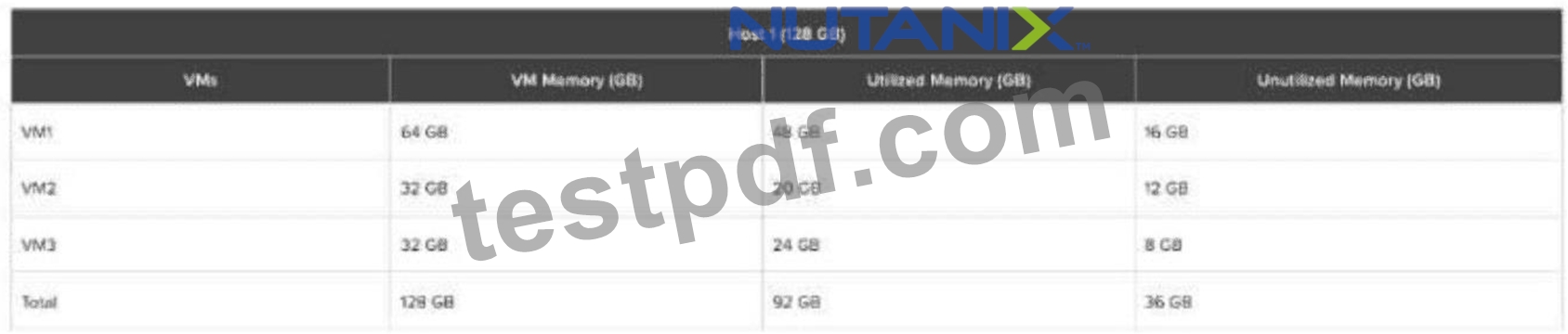
An administrator needs to create two virtual machines: VM4 and VM5 that leverage the memory over-commit feature.
Once VM4 is created and running, the administrator notices that it uses only 28GB of RAM.
What will be the maximum RAM that can be allocated to VM5 so that it can be powered on?
- A. 32GB
- B. 8GB
- C. 4GB
- D. 16GB
Answer: B
Explanation:
Understanding the Exhibit & Memory Allocation
* Thehost has 128GB of physical RAM.
* Thecurrent memory allocationacrossthree VMs (VM1, VM2, VM3) is 128GB, but only92GB is actually utilized.
* This means there is36GB of unutilized memory available for allocation.
Step-by-Step Breakdown
* Existing Memory Usage Before Adding VM4
* Total Physical RAM:128GB
* Used by running VMs (VM1, VM2, VM3):92GB
* Unutilized Memory Available:36GB
* After Creating and Running VM4
* VM4 is allocatedmemory but only utilizes 28GB.
* The table does not show VM4's allocated RAM, but assuming it was given a reasonable allocation, it must have been taken from the36GB unutilized memory pool.
* IfVM4 uses 28GB, theremaining unutilized memory is now (36GB - 28GB) = 8GB.
* Maximum Memory Allocation for VM5
* Sinceonly 8GB remains unutilized, the maximum memory VM5 can be allocated while still allowing it to power on is8GB.
Evaluating the Answer Choices
* (A) 4GB#(Incorrect)
* More memory (8GB) is available, so limiting to 4GB is unnecessary.
* (B) 8GB#(Correct)
* Theremaining unutilized memory after VM4 is 8GB, so VM5 can be allocated up to8GBwhile ensuring it can power on.
* (C) 16GB#(Incorrect)
* Only8GB is left, so 16GB isnot possible.
* (D) 32GB#(Incorrect)
* There isnot enough unutilized memoryto allocate 32GB.
Key Concept: Nutanix Memory Overcommit
* Nutanix AHV supportsmemory overcommit, meaning VMs can be allocated more memory than physically available usingmemory ballooning and swapping.
* However,to power on VM5 without impacting performance, it must fit within the available unutilized memory, which is8GB.
NEW QUESTION # 51
An administrator was tasked with configuring a Nutanix Disaster Recovery solution and has established synchronous replication between the sites. For additional resiliency, each site is running its own Prism Central instance managing the local AHV cluster.
An administrator was notified that a failover is required for a planned datacenter maintenance on the primary site.
In which two ways should the administrator proceed? (Choose two.)
- A. Perform on-demand live migration between the clusters.
- B. Conduct a planned failover from the primary site
- C. Conduct a planned failover from the standby site.
- D. Conduct an unplanned failover from the primary site.
Answer: B,C
Explanation:
When synchronous replication has been configured and a planned failover is required for datacenter maintenance, Nutanix recommends performing aplanned failoverto ensure data consistency and a clean transition of services.
From theNutanix Enterprise Cloud Administration (ECA)course materials:
"A planned failover ensures that data replication is complete and consistent between the primary and standby sites before the workload is migrated. This prevents data loss and ensures seamless recovery." Additionally:
"A planned failover can be initiated either from the primary site or from the standby site. This provides flexibility depending on operational preferences and site availability during maintenance windows."
"Unplanned failovers should only be used in the event of unexpected site outages or catastrophic failures, as they may involve data loss or incomplete synchronization." Therefore, the correct approaches are to conduct a planned failover either from the standby site (B) or from the primary site (D). This ensures seamless workload transition during the datacenter maintenance event.
NEW QUESTION # 52
When expanding acluster, what is required toautomatically discover new nodes?
- A. New nodes must have the same AOS version.
- B. IPv4 multicast must be allowed on physical switches.
- C. New nodes must have the same hypervisor version.
- D. IPv6 multicast must be allowed on physical switches.
Answer: D
Explanation:
As per the Nutanix Prism Web Console Guide (v7.0), specifically at this page:
Expand Cluster - Node Discovery, it is clearly mentioned that:
"The expand cluster discovery step (finding nodes to add) requires that IPv6 multicast packets are allowed through the physical switch. Therefore, the expand cluster process does not work when IPv6 is disabled in your network." This directly confirms that for automatic discovery of new nodes, IPv6 multicast must be enabled and allowed on the physical switches connecting Nutanix nodes. This is a recent update in the cluster expansion discovery process that replaces the previous use of IPv4 multicast in earlier Nutanix AOS versions.
NEW QUESTION # 53
An administrator experiences a Recovery Plan failure for a cross-hypervisor (ESXi to AHV) DR test. Guest VMs do not recover at the DR location.
Which configuration is required for a successful event?
- A. Nutanix Guest Tools must be installed on source guest VMs.
- B. Deploy Legacy BIOS boot on hosts within the cluster.
- C. Utilize delta disks.
- D. Use raw device mappings.
Answer: A
Explanation:
Nutanix documentation for Cross-Hypervisor Disaster Recovery (CH-DR) specifies that Nutanix Guest Tools (NGT) must be installed on all VMs participating in ESXi to AHV recovery workflows. NGT includes the VM Mobility Drivers, which are required for the VM to interpret AHV device models, storage controllers, and network adapters during recovery. The documentation notes that without NGT installed, VMs may fail to boot or attach devices correctly after being recovered on AHV. Legacy BIOS, RDMs, and delta disks are not listed as prerequisites or contributing factors for CH-DR success. Therefore, installing Nutanix Guest Tools on the source VM is mandatory for successful cross-hypervisor recovery.
NEW QUESTION # 54
An administrator is configuringProtection Policiesto replicate VMs to aNutanix Cloud Cluster (NC2)over the internet.
To comply with security policies, how should data be protected during transmission?
- A. Enable Data-at-Rest Encryption.
- B. Configure VMs to use UEFI Secure Boot.
- C. Configure Data on a self-encrypting drive.
- D. Enable Data-in-Transit Encryption.
Answer: D
Explanation:
Data-in-Transit Encryption ensures that replication traffic is encrypted while being sent over the internet.
* Option D (Enable Data-in-Transit Encryption) is correct:
* This encryptsreplicated data between clusters, ensuring security againstman-in-the-middle attacks.
* Option A (Self-encrypting drive) is incorrect:
* This protects data at rest, not during transmission.
* Option B (UEFI Secure Boot) is incorrect:
* Secure Boot prevents unauthorized OS modifications, but doesnot encrypt network traffic.
* Option C (Data-at-Rest Encryption) is incorrect:
* This encryptsstored data but does not secure replication traffic.
References:
* Nutanix Security Guide #Configuring Data-in-Transit Encryption
* Nutanix KB #Protecting Replication Traffic Over Public Networks
NEW QUESTION # 55
Upon reaching the maximum instances of retained reports, what occurs?
- A. Reporting failure is reported.
- B. New reporting is delayed.
- C. Manual deletion is required.
- D. Oldest report is deleted
Answer: D
Explanation:
When the maximum instance count of retained reports is reached, Nutanix automatically deletes the oldest report to accommodate the new one.
From theNutanix Enterprise Cloud Administration (ECA)course materials:
"To ensure storage and performance efficiency, Nutanix reporting limits the number of stored reports. If this maximum is reached, the oldest report instance is automatically deleted to make space for new reports."
NEW QUESTION # 56
A Disaster Recovery administrator has setup a Protection Policy for 50 workloads - all configured in a similar fashion in terms of OS, storage, network, and performance. The RPO is 60 minutes with a specified retention of 10 copies local, 5 copies remote, and crash consistency.
After configuring the Protection Policy and activating it, the administrator has noticed that recovery points are not showing up in DR. Yet, everything within the Protection Policy looks correct and recovery points are showing up on production side.
What is the most likely issue?
- A. The storage container RF factor of the protected VMs is not the same as the RF factor in the DR cluster container.
- B. The storage container name of the protected VMs is not the same as the DR cluster storage container
- C. Nutanix NGT is not installed on the source VMs.
- D. Windows updates need to be run on all the affected VMs.
Answer: A
Explanation:
In Nutanix Protection Domain-based replication, both thesourceanddestinationstorage containersmust have the same Replication Factor (RF)to ensure consistent data protection and replication. This is a key requirement for the data's protection and integrity.
From theNutanix ECAdocumentation:
"Replication and recovery require that the source and destination containers have the same RF setting (either RF2 or RF3). If the RF does not match, replication and recovery points will not be generated in the DR site." The other options:
* A (NGT): NGT is not required for crash-consistent protection.
* C (Windows updates): Updates are not directly relevant to replication consistency.
* D (container name): Names can differ; what matters is the container's RF setting.
NEW QUESTION # 57
An administrator is configuring areplication scheduleonmultiple remote locationsdeployed using asingle-node cluster. The goal is to achieve thelowest possible RPO (Recovery Point Objective).
How should the administrator configure the replication schedule?
- A. Configure Async replication.
- B. Configure a schedule for 1 minute up to 15 minutes.
- C. Configure NearSync replication.
- D. Configure a schedule for 16 minutes up to 59 minutes.
Answer: A
NEW QUESTION # 58
In anRF2 cluster, what is theminimum number of nodes requiredto allow ahost removal?
- A. 0
- B. 1
- C. 2
- D. 3
Answer: C
Explanation:
In a Nutanix cluster, Replication Factor 2 (RF2) means that each piece of data has two copies: a primary and a replica. To safely remove a node while ensuring data redundancy and cluster health, the system must have enough nodes to maintain the RF2 protection and complete the removal.
From the Nutanix Enterprise Cloud Administration (ECA) documentation:
"The minimum number of nodes required for a safe host removal in an RF2 cluster is four. This ensures that even after removing a node, there are enough remaining nodes to continue hosting the primary and replica data copies, meeting the RF2 requirement." The logic is:
* In a 3-node RF2 cluster, there isn't enough redundancy to safely remove a node without impacting data availability.
* A 4-node RF2 cluster allows safe removal of one node while still ensuring two copies of all data remain.
Thus, the minimum number of nodes required for a safe host removal in an RF2 cluster is 4
NEW QUESTION # 59
......
NCP-MCI-6.10 Exam Practice Questions prepared by Nutanix Professionals: https://freedumps.testpdf.com/NCP-MCI-6.10-practice-test.html
