

Easily To Pass New Oracle 1Z0-149 Dumps with 67 Questions
Latest 1Z0-149 Study Guides 2026 - With Test Engine PDF
How to prepare for the Oracle 1Z0-149 Certification Exam
The best way to get ready for the Oracle 1Z0-149 Certification Exam
This content is for people who don't have time to cover the whole syllabus.
Oracle 1Z0-149 Certification Exam is an exam for beginners who are seeking certification. This exam has been designed for the candidates, who want to get certified as database developers. The candidates should have good knowledge of SQL, PL/SQL, and ODP. These exams will help you in taking up a job, which is related to the database. In this article, we are going to discuss all the topics that are required for the preparation of the Oracle Database Program with the PL/SQL exam. The number of resources including 1Z0-149 exam dumps will also be discussed. You can consider all of these sources for the preparation of the Oracle Certification Exam. Information about the 1Z0-149 Certification Exam, like exam duration, passing marks, and the exam format will also be discussed in this article. You can also find out more about the test structure along with sample questions. So, don't take up a lot of your time, and let's start learning for success.
NEW QUESTION # 39
Which three are true about DDL triggers? (Choose three.)
- A. They fire only when a DDL statement is executed by the owner of the trigger.
- B. They must be created in an enabled state.
- C. They cannot include the WHEN clause.
- D. They must be created in a disabled state.
- E. They can be fired when a table is truncated.
- F. They can be fired when a privilege is granted to a user.
- G. They can be fired either before or after a DDL statement executes.
Answer: A,E,G
NEW QUESTION # 40
Examine this row of data from the EMPLOYEES table:
Now, examine this block of code which executes successfully:
What is the value of v_commission?
- A. 0
- B. 1
- C. 2
- D. 3
Answer: C
NEW QUESTION # 41
Which two are true about the PLSQL_CODE_TYPE parameter? (Choose two.)
- A. If set to NATIVE, programs are stored in platform dependent machine code.
- B. If set to NATIVE, programs are stored in a PL/SQL bytecode format.
- C. It can use the REUSE SETTINGS clause to recompile a program unit without changing to the current session settings.
- D. The default value is NATIVE.
- E. Changing the parameter setting automatically changes the setting for existing PL/SQL library units.
Answer: A,C
NEW QUESTION # 42
Examine this table definition in the SH schema.
A row with PDT_ID = 1 exists. Which two blocks of code will execute successfully by user SH and give the same output? (Choose two.)
- A.

- B.

- C.
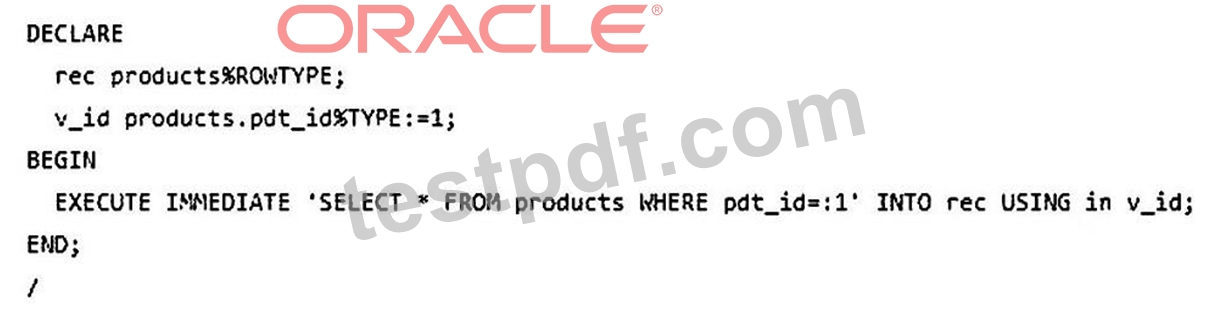
- D.

Answer: C,D
NEW QUESTION # 43
Which is true about EXIT and CONTINUE statements?
- A. They can be used in any type of loop.
- B. They must have a WHEN condition.
- C. They must use labels.
- D. They have the same effect on the execution of a loop.
Answer: A
NEW QUESTION # 44
Examine these statements from a block of code:
Which two are true? (Choose two.)
- A. The FOR UPDATE OF clause can be used only if the WHERE CURRENT OF clause is used in the executable part of the block.
- B. The lock acquired when executing the OPEN c1 command will be released only after a COMMIT or ROLLBACK statement is issued.
- C. An OPEN c1 command will acquire a lock only on the PRICE column in the PRODUCTS table.
- D. Only the PRICE column can be updated in the PRODUCTS table.
- E. The WHERE CURRENT OF clause can be used only if the FOR UPDATE clause is used in the cursor definition.
Answer: B,E
NEW QUESTION # 45
Examine these statements:
Which two are true? (Choose two.)
- A. Only one table will have a row inserted and committed.
- B. The transaction for the bank_activity_proc is independent of the bank_transaction_proc.
- C. Both tables will have a row inserted and committed.
- D. Neither table will have a row inserted and committed.
- E. The bank_activity_proc will not compile because of the commit.
Answer: A,B
NEW QUESTION # 46
Which three are valid PL/SQL variable names? (Choose three.)
- A. #printer_name
- B. Number_of_days_between_March_and_April
- C. 1to7number
- D. printer_name#
- E. yesterday's_date
- F. leap$year
- G. v_fname
Answer: D,F,G
NEW QUESTION # 47
SERVEROUTPUT is enabled.
Which code block will display the values from 1 to 10 in descending order?
- A.

- B.

- C.

- D.

Answer: A
NEW QUESTION # 48
Which two are true about named notations in a PL/SQL subprogram? (Choose two.)
- A. Any optional parameters can be omitted in the invocation call.
- B. Only trailing optional parameters can be omitted in the invocation call.
- C. The subprogram invocations must be changed when the formal parameter list acquires new required parameters.
- D. The actual parameters must be specified in the same order as the formal parameters are declared.
- E. Specifying actual parameters in the wrong order results in the subprogram terminating with an exception.
Answer: A,D
NEW QUESTION # 49
Which three are true about the NOCOPY hint, the PARALLEL ENABLE hint, and the DETERMINISTIC clause? (Choose three.)
- A. The PARALLEL_ENABLE clause can be specified for a nested function.
- B. A deterministic function's results always depend on the state of session variables.
- C. The NOCOPY hint asks the compiler to pass the actual parameters by value.
- D. A function defined with the PARALLEL_ENABLE clause may be executed in parallel in a SELECT statement or a subquery in a DML statement.
- E. The PARALLEL_ENABLE clause can be used only in the CREATE FUNCTION statement.
- F. The NOCOPY hint asks the compiler to pass the actual parameters by reference.
- G. A function is deterministic if it always returns the same result for a specific combination of input values.
Answer: D,F,G
NEW QUESTION # 50
Which two are true about lexical units? (Choose two.)
- A. Character literals are case-sensitive.
- B. All user-defined identifiers must start with an alphabet.
- C. Identifiers include labels.
- D. A character literal with zero characters has the BOOLEAN value NULL.
- E. Spaces can be embedded in delimiters.
Answer: A,B
NEW QUESTION # 51
Examine this statement which executes successfully:
SQL> SET SERVEROUTPUT ON;
Now, examine this code which is executed:
What is true about the result?
- A. It returns an error in line 2.
- B. It returns an error in line 9.
- C. It executes and displays output.
- D. It returns an error in line 4.
Answer: D
NEW QUESTION # 52
In one of your databases, table HR.EMPLOYEES includes the columns FIRST_NAME and EMPLOYEE_ID.
A row exists with EMPLOYEE_ID 201.
Examine these packages created by user HR:
EXECUTE privilege is granted to user SH, on the HR.API and HR.HELPER packages.
Which two will execute successfully? (Choose two.)
- A. Call HR.HELPER.H1 from the SH schema.
- B. Call HR.API.P1 from the SH schema.
- C. Call HR.API.P1 from the HR schema.
- D. Call HR.HELPER.H1 from the HR schema.
- E. Create and call a package procedure API.H1 in the SH schema, which calls HR.HELPER.H1.
Answer: A,B
NEW QUESTION # 53
Examine these statements which execute successfully:
Which anonymous block executes successfully?
- A.

- B.

- C.

- D.

Answer: B
NEW QUESTION # 54
Which two are true about packages? (Choose two.)
- A. Modifications to a packaged procedure's body automatically cause recompilation of subprograms that invoke the procedure.
- B. A package definition must have a specification and body.
- C. Standalone subprograms that reference a package can be compiled only after both the package specification and body are compiled.
- D. Variables and cursors defined in a package specification are visible to all subprograms in the same schema that has the package.
- E. Package specifications can be compiled without their bodies.
Answer: D,E
NEW QUESTION # 55
Which two are true about Conditional Compilation in PL/SQL using $IF, $ELSE, $END, and $ERROR? (Choose two.)
- A. PL/SQL code can be compiled and executed based on different versions of the operating system.
- B. The PL/SQL compiler can conditionally include selected parts of a program.
- C. Conditional compilation is disabled by default.
- D. PL/SQL code can be compiled and executed based on different versions of Oracle.
- E. It is newer syntax that works the same way as 'IF , ELSEIF , ELSE, and END IF'.
Answer: B,D
NEW QUESTION # 56
Examine this table in the SH schema:
Now, examine this code:
Which two changes are required to ensure that PDT_REPORT executes successfully? (Choose two.)
- A. In line 1, add the default parameter DEFAULT 2000.
- B. In line 2, add the default parameter DEFAULT 2000.
- C. In line 1, change IN OUT mode to IN mode.
- D. In line 3, replace CUR_PRICE with P_PDT_PRICE in the query condition.
- E. In line 2, change IN OUT mode to IN mode.
- F. In line 6, replace P_PDT_PRICE parameter name with CUR_PRICE.
Answer: A,E
NEW QUESTION # 57
Examine this DECLARE section:
Which line will cause an error upon execution?
- A. line 4
- B. line 5
- C. line 6
- D. line 3
- E. line 2
Answer: C
NEW QUESTION # 58
Which block of code displays the error message "Incorrect price value"?
- A.

- B.

- C.

- D.

Answer: A
NEW QUESTION # 59
Examine these statements:
Which is true?
- A. It will result in a successful compilation because objects referenced in an ACCESSIBLE BY clause are not checked at compile time.
- B. With adequate privileges, PROTECTED_PROC procedure can be called by other programs apart from CALLING_PROC.
- C. It will result in a compilation error for protected_proc because calling_proc must be prefixed with the schema name.
- D. It will result in a compilation error for protected_proc because calling_proc does not exist.
Answer: D
NEW QUESTION # 60
Examine this code:
ALTER SESSION SET plsql_warnings='ENABLE:ALL';
/
You compile this function:
What happens when the function is created with PLSQL_WARNINGS set to 'ENABLE: ALL'?
- A. It fails compilation.
- B. A severe compilation warning is generated.
- C. A performance compilation warning is generated.
- D. There are no compilation warnings or errors.
- E. An information compilation warning is generated.
Answer: C
NEW QUESTION # 61
Examine this DECLARE section: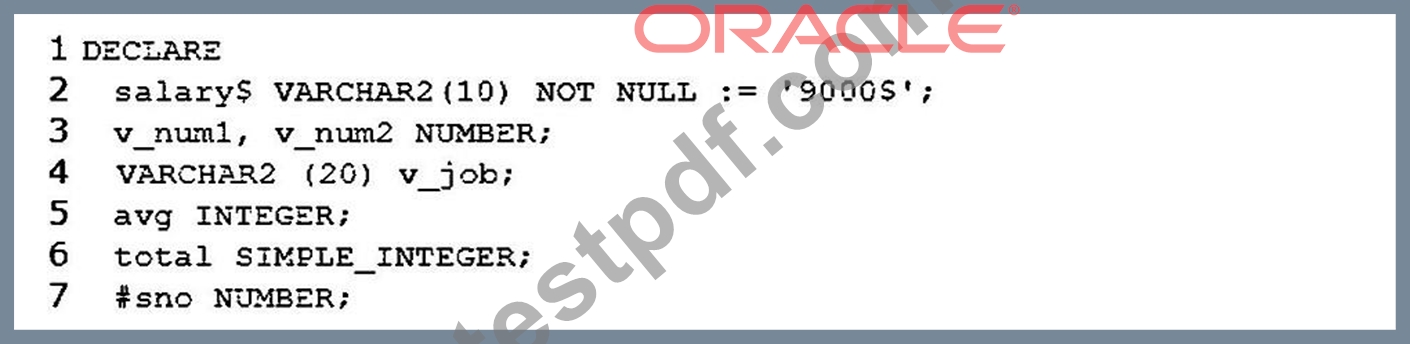
Which two lines are valid? (Choose two.)
- A. line 2
- B. line 7
- C. line 4
- D. line 3
- E. line 6
- F. line 5
Answer: A,F
NEW QUESTION # 62
......
Oracle 1z1-149 exam is a must-have certification for developers, database administrators, and database architects who want to demonstrate their understanding and proficiency in programming using PL/SQL in the Oracle Database 19c environment. By passing the exam, candidates can prove their ability to write efficient and high-performing PL/SQL code, design and implement PL/SQL programs, and troubleshoot issues related to PL/SQL code. Oracle Database 19c: Program with PL/SQL certification also demonstrates the candidate's commitment to professional development and can help them stand out in a competitive job market.
1Z0-149 Dumps and Exam Test Engine: https://freedumps.testpdf.com/1Z0-149-practice-test.html
